Portrait of Oriel Kiss

Oriel Kiss

Developing quantum algorithms for the simulation of strongly correlated quantum systems, with a focus on Hamiltonian simulation, ground-state preparation and fault-tolerant quantum computing.

Quantum Algorithm Engineer at IQM Quantum Computers

About

I'm a computational physicist developing quantum algorithms for many-body simulation, with an emphasis on resource-efficient and fault-tolerant methods. I currently work as a Quantum Algorithm Engineer at IQM Quantum Computers.

I completed my Ph.D. in Quantum Computing at the University of Geneva in 2025, in collaboration with the CERN Quantum Technology Initiative. My doctoral work started with randomized algorithms and error mitigation for near-term devices, and moved towards early fault-tolerant algorithms for ground-state energy estimation and the question of when randomization actually pays off in Hamiltonian simulation.

Along the way, I've been a research intern at Google Quantum AI, Xanadu and IBM Quantum, a visiting researcher at the University of Trento, and an ML Research Scientist at Giotto AI.

Quantum algorithms
Hamiltonian simulation, ground-state preparation, randomized algorithms, fault-tolerant resource estimation
Many-body physics
Nuclear and neutrino physics, quantum spin models, phase transitions, strongly correlated systems
Computational methods
Quantum and classical machine learning, stochastic methods, hybrid algorithms, error mitigation

Selected research

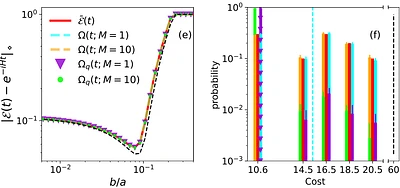
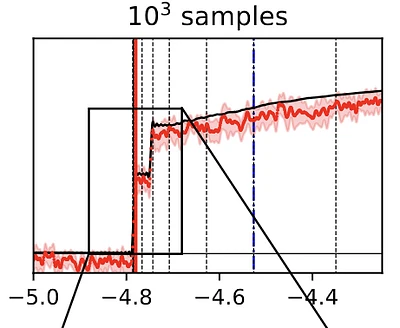
Estimated cumulative distribution function with detected jump near the ground-state energy

Early fault-tolerant ground-state energy estimation

Algorithms that estimate ground-state energies from the cumulative distribution function of a Hamiltonian's spectral measure, built for the regime where the initial state's quality is unknown. We proposed a signal-processing approach that finds the estimate automatically.

ResultOn a 26-qubit Heisenberg model with a cheap DMRG initial state, the method matched converged DMRG energies with an order of magnitude fewer samples than binary search.
Quantum 9, 1682 (2025)

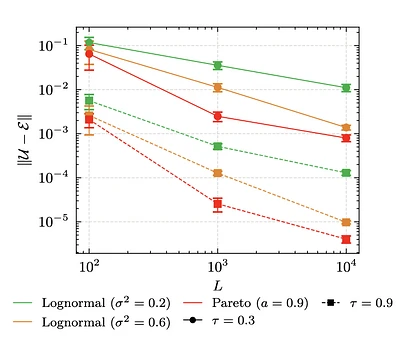
Simulation error versus cost for randomized and deterministic methods

Randomized Hamiltonian simulation

Stochastic methods for quantum simulation. We proposed to weight terms according to their hardware cost, studied where random simulation can yield an advantage, and introduced a partially randomized LCU construction.

ResultFor many-term Hamiltonians with very uneven coefficients, randomization cuts gate counts by up to an order of magnitude, but only at moderate precision. Deterministic methods win below an error of about 10−3.

Quantum 7, 977 (2023) · arXiv:2604.07448 (2026)

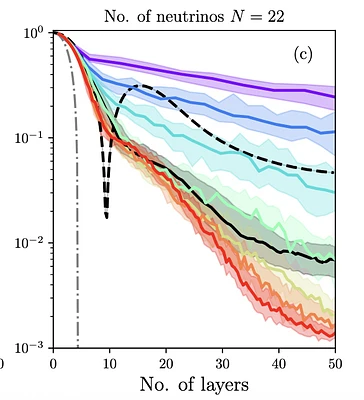
Neutrino flavour thermalization versus circuit depth for 22 neutrinos

Nuclear and neutrino physics on quantum computers

Quantum simulation of atomic nuclei from effective field theory, and of collective neutrino flavour dynamics, together with error-mitigation techniques to make these computations on today's hardware.

ResultDeuteron and 3He bound states reproduced within 100 keV with modest circuit depth; neutrino flavour thermalization simulated on more than 100 qubits, with thermalization time growing roughly as the square root of system size.

PRC 113 (2026) · Commun. Phys. 9 (2026) · PRD 111 (2025) · PRC 106 (2022)

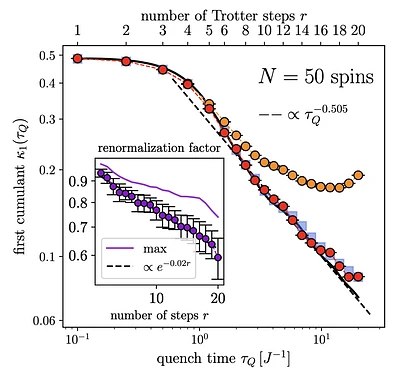
Kink density versus quench time showing power-law scaling

Quantum phase transitions on quantum hardware

Using quantum processors to study critical behaviour: defect formation when a phase transition is crossed in finite time, finite-size criticality in spin models, and state preparation across phase boundaries.

ResultOn quantum processors with up to 100 qubits, the higher-order statistics of topological defects in the transverse-field Ising model follow a universal power law in the quench time, extending Kibble–Zurek scaling beyond the average defect density.

QST 10 (2025) · NJP 26 (2024) · PRE 107 (2023)

Publications

17 publications · 16 peer-reviewed, 1 preprint · Google Scholar · ORCID

No matching publications.

2026

Figure from the paper

Neutrino thermalization via randomization on a quantum processor

O. Kiss, I. Tavernelli, F. Tacchino, D. Lacroix, A. Roggero
Communications Physics 9, 282 (2026)
PaperarXivData
Abstract

The dynamical evolution of neutrino flavor in supernovae can be modeled by an all-to-all spin Hamiltonian with random couplings. Simulating such two-local Hamiltonian dynamics remains a major challenge, as methods with controllable accuracy require circuit depths that increase at least linearly with system size, exceeding the capabilities of current quantum devices. The eigenstate thermalization hypothesis predicts that these systems should thermalize, a behavior confirmed in small-scale classical simulations. Here we investigate flavor thermalization in much larger systems using random quantum circuits as an empirical tool to emulate the non-local dynamics, and demonstrate that thermal behavior can be reproduced using a depth independent of system size. By simulating systems of over one hundred qubits, we find that the thermalization time grows approximately as the square root of the system size, consistent with predictions from semi-classical methods. Our study also illustrates that near-term quantum devices are useful tools to test and validate empirical classical methods, and highlights an application of random circuits in physics.

Figure from the paper

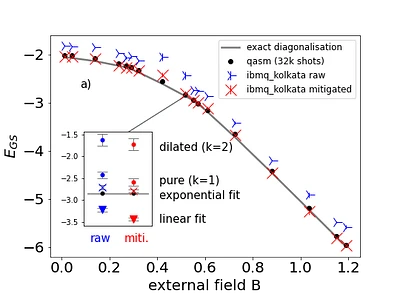
Double-bracket quantum algorithms for high-fidelity ground state preparation

M. Robbiati, E. Pedicillo, A. Pasquale, X. Li, O. Kiss, A. Wright, R. M. S. Farias, K. U. Giang, J. Son, J. Knörzer, S. T. Goh, J. Y. Khoo, N. H. Y. Ng, Z. Holmes, S. Carrazza, M. Gluza
Physical Review Research 8, 033078 (2026)
PaperarXivCode
Abstract

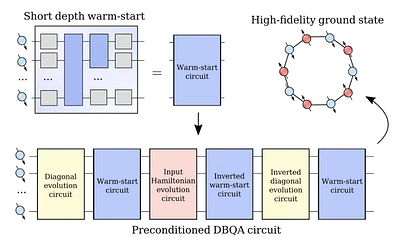
Ground state preparation is a central application for quantum computers but remains challenging in practice. In this work, we quantitatively investigate the performance and gate counts of double-bracket quantum algorithms (DBQAs) for ground state preparation. We propose a practical strategy in which DBQAs refine initial state preparation circuits, and we compile them for Heisenberg chains using controlled-Z and single-qubit gates. Warm-started DBQAs consistently improve both the energy and ground-state fidelity relative to the initial states provided by variational ansätze, indicating that DBQAs offer an effective unitary synthesis method. To demonstrate compatibility with near-term hardware, we executed a proof-of-concept example on IBM devices. With error mitigation, we observed a statistically significant improvement over the corresponding warm-start circuit. Furthermore, numerical emulations for the same system size indicate that executing DBQAs on Quantinuum's hardware could achieve similar cost-function gains without requiring error mitigation. These findings suggest that DBQAs are a promising approach for enhancing ground-state approximations on near-term quantum devices.

Figure from the paper

When is randomization advantageous in quantum simulation?

F. Paganelli, M. Grossi, A. Giachero, T. E. O'Brien, O. Kiss
arXiv:2604.07448 (2026) Preprint
arXiv
Abstract

We study the regimes in which Hamiltonian simulation benefits from randomization. We introduce a sparse-QSVT construction based on composite stochastic decompositions, where dominant terms are treated deterministically and smaller contributions are sampled stochastically. Crucially, we analyze how stochastic and approximation errors propagate through block-encoding and QSVT procedures. To benchmark this approach, we construct ensembles of random Hamiltonians with controlled coefficient dispersion, locality, and number of terms, designed to favor randomization, and therefore providing an upper bound on its practical advantage. For Hamiltonians with many terms and highly inhomogeneous coefficient distributions, randomized methods reduce gate counts by up to an order of magnitude. However, this advantage is confined to moderate-precision regimes: as the target error decreases, deterministic methods become more efficient, with a crossover near ε ∼ 10−3. Although this regime partially overlaps with quantum chemistry Hamiltonians, realistic systems exhibit additional structure, such as commutation patterns, not captured by our model, which are expected to further favor deterministic approaches.

Figure from the paper

Towards scalable quantum computations of atomic nuclei

C. Gu, M. Heinz, O. Kiss, T. Papenbrock
Physical Review C 113, 034321 (2026)
PaperarXivCode
Abstract

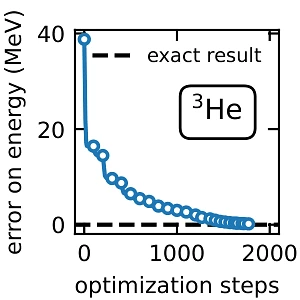
We solve the nuclear two-body and three-body bound states via quantum simulations of pionless effective field theory on a lattice in position space. While the employed lattice remains small, the usage of local Hamiltonians including two- and three-body forces ensures that the number of Pauli terms scales linearly with increasing numbers of lattice sites. We use an adaptive ansatz grown from unitary coupled cluster theory to parametrize the ground states of the deuteron and 3He, compute their corresponding energies, and analyze the scaling of the required computational resources. Our quantum simulations reproduce exact benchmarks for 2H and 3He within 100 keV, requiring at most 30 layers in the ansatz and thus resulting in modest circuit depths. Additionally, we find the number of shots required to reach a given precision scales linearly in the lattice size and more mildly in the system size. Based on the agreement with exact benchmarks and mild scaling, we conclude that this can be an efficient, scalable approach for quantum computations of nuclear ground states, particularly to prepare initial states for quantum phase estimation or other filtering algorithms.

2025

Figure from the paper

Statistics of topological defects across a phase transition in a superconducting quantum processor

O. Kiss, D. Teplitskiy, M. Grossi, A. Mandarino
Quantum Science and Technology 10, 035037 (2025)
PaperarXiv
Abstract

When a quantum phase transition is crossed within a finite time, critical slowing down disrupts adiabatic dynamics, resulting in the formation of topological defects. The average density of these defects scales with the quench rate, adhering to a universal power law as predicted by the Kibble-Zurek mechanism (KZM). In this study, we aim to investigate the counting statistics of kink density in the 1D transverse-field quantum Ising model. We demonstrate on multiple quantum processing units up to 100 qubits, that higher-order cumulants follow a universal power law scaling as a function of the quench time. We also show the breakdown of the KZM for short quenches for finite-size systems. Tensor network simulations corroborate our quantum simulation results for bigger systems not in the asymptotic limit.

Figure from the paper

Symmetry-invariant quantum machine learning force fields

I. N. M. Le, O. Kiss, J. Schuhmacher, I. Tavernelli, F. Tacchino
New Journal of Physics 27, 023015 (2025)
PaperarXivDemo
Abstract

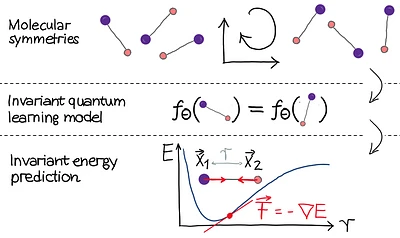
Machine learning techniques are essential tools to compute efficient, yet accurate, force fields for atomistic simulations. This approach has recently been extended to incorporate quantum computational methods, making use of variational quantum learning models to predict potential energy surfaces and atomic forces from ab initio training data. However, the trainability and scalability of such models are still limited, due to both theoretical and practical barriers. Inspired by recent developments in geometric classical and quantum machine learning, here we design quantum neural networks that explicitly incorporate, as a data-inspired prior, an extensive set of physically relevant symmetries. We find that our invariant quantum learning models outperform their more generic counterparts on individual molecules of growing complexity. Furthermore, we study a water dimer as a minimal example of a system with multiple components, showcasing the versatility of our proposed approach and opening the way towards larger simulations. Our results suggest that molecular force fields generation can significantly profit from leveraging the framework of geometric quantum machine learning, and that chemical systems represent, in fact, an interesting and rich playground for the development and application of advanced quantum machine learning tools.

Figure from the paper

Quantum error mitigation for Fourier moment computation

O. Kiss, M. Grossi, A. Roggero
Physical Review D 111, 034504 (2025)
PaperarXiv
Abstract

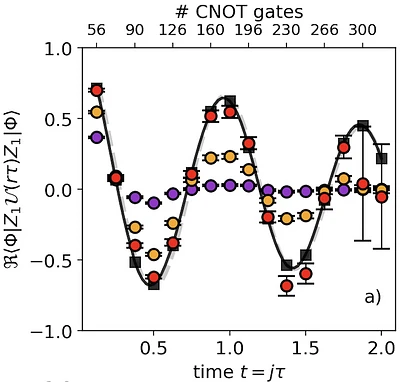
Hamiltonian moments in Fourier space — expectation values of the unitary evolution operator under a Hamiltonian at different times — provide a convenient framework to understand quantum systems. They offer insights into the energy distribution, higher-order dynamics, response functions, correlation information and physical properties. This paper focuses on the computation of Fourier moments within the context of a nuclear effective field theory on superconducting quantum hardware. The study integrates echo verification and noise renormalization into Hadamard tests using control reversal gates. These techniques, combined with purification and error suppression methods, effectively address quantum hardware decoherence. The analysis, conducted using noise models, reveals a significant reduction in noise strength by two orders of magnitude. Moreover, quantum circuits involving up to 266 CNOT gates over five qubits demonstrate high accuracy under these methodologies when run on IBM superconducting quantum devices.

2024

Figure from the paper

Trainability barriers and opportunities in quantum generative modeling

M. S. Rudolph, S. Lerch, S. Thanasilp, O. Kiss, S. Vallecorsa, M. Grossi, Z. Holmes
npj Quantum Information 10, 116 (2024)
PaperarXiv
Abstract

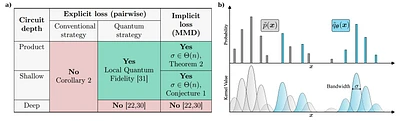
Quantum generative models provide inherently efficient sampling strategies and thus show promise for achieving an advantage using quantum hardware. In this work, we investigate the barriers to the trainability of quantum generative models posed by barren plateaus and exponential loss concentration. We explore the interplay between explicit and implicit models and losses, and show that using quantum generative models with explicit losses such as the KL divergence leads to a new flavour of barren plateaus. In contrast, the implicit Maximum Mean Discrepancy loss can be viewed as the expectation value of an observable that is either low-bodied and provably trainable, or global and untrainable depending on the choice of kernel. In parallel, we find that solely low-bodied implicit losses cannot in general distinguish high-order correlations in the target data, while some quantum loss estimation strategies can. We validate our findings by comparing different loss functions for modelling data from High-Energy-Physics.

Figure from the paper

Hybrid ground-state quantum algorithms based on neural Schrödinger forging

P. de Schoulepnikoff, O. Kiss, S. Vallecorsa, G. Carleo, M. Grossi
Physical Review Research 6, 023021 (2024)
PaperarXivCode
Abstract

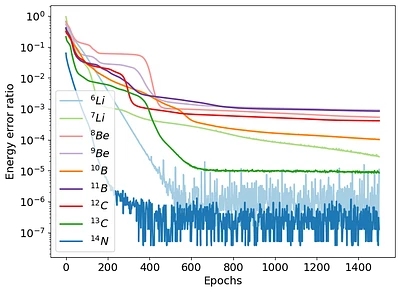
Entanglement forging based variational algorithms leverage the bi-partition of quantum systems for addressing ground state problems. The primary limitation of these approaches lies in the exponential summation required over the numerous potential basis states, or bitstrings, when performing the Schmidt decomposition of the whole system. To overcome this challenge, we propose a new method for entanglement forging employing generative neural networks to identify the most pertinent bitstrings, eliminating the need for the exponential sum. Through empirical demonstrations on systems of increasing complexity, we show that the proposed algorithm achieves comparable or superior performance compared to the existing standard implementation of entanglement forging. Moreover, by controlling the amount of required resources, this scheme can be applied to larger, as well as non permutation invariant systems, where the latter constraint is associated with the Heisenberg forging procedure. We substantiate our findings through numerical simulations conducted on spins models exhibiting one-dimensional ring, two-dimensional triangular lattice topologies, and nuclear shell model configurations.

Figure from the paper

Counterdiabatic optimized driving in quantum phase sensitive models

F. P. Barone, O. Kiss, M. Grossi, S. Vallecorsa, A. Mandarino
New Journal of Physics 26, 033031 (2024)
PaperarXivCode
Abstract

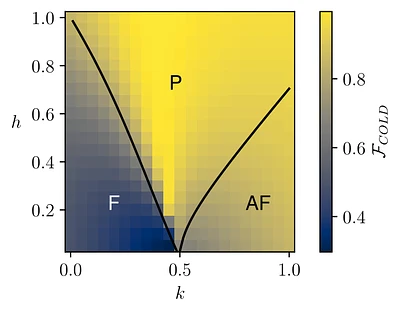
State preparation plays a pivotal role in numerous quantum algorithms, including quantum phase estimation. This paper extends and benchmarks counterdiabatic driving protocols across three one-dimensional spin systems characterized by phase transitions: the axial next-nearest neighbor Ising (ANNNI), XXZ, and Haldane-Shastry (HS) models. We perform quantum optimal control protocols by optimizing the energy cost function, which can always be evaluated as opposed to the fidelity one requiring the exact state. Moreover, we incorporate Bayesian optimization within a code package for computing various adiabatic gauge potentials. This protocol consistently surpasses standard annealing schedules, often achieving performance improvements of several orders of magnitude. Notably, the ANNNI model stands out as a notable example, where fidelities exceeding 0.5 are attainable in most cases. Furthermore, the optimized paths exhibits promising generalization capabilities to higher-dimensional systems, allowing for the extension of parameters from smaller models. This opens up possibilities for applying the protocol to higher-dimensional systems. However, our investigations reveal limitations in the case of the XXZ and HS models, particularly when transitioning away from the ferromagnetic phase. This suggests that finding optimal diabatic gauge potentials for specific systems remains an important research direction.

2023

Figure from the paper

Finite-size criticality in fully connected spin models on superconducting quantum hardware

M. Grossi, O. Kiss, F. De Luca, C. Zollo, I. Gremese, A. Mandarino
Physical Review E 107, 024113 (2023)
PaperarXiv
Abstract

The emergence of a collective behavior in a many-body system is responsible of the quantum criticality separating different phases of matter. Interacting spin systems in a magnetic field offer a tantalizing opportunity to test different approaches to study quantum phase transitions. In this work, we exploit the new resources offered by quantum algorithms to detect the quantum critical behaviour of fully connected spin-1/2 models. We define a suitable Hamiltonian depending on an internal anisotropy parameter γ, that allows us to examine three paradigmatic examples of spin models, whose lattice is a fully connected graph. We propose a method based on variational algorithms run on superconducting transmon qubits to detect the critical behavior for systems of finite size. We evaluate the energy gap between the first excited state and the ground state, the magnetization along the easy-axis of the system, and the spin-spin correlations. We finally report a discussion about the feasibility of scaling such approach on a real quantum device for a system having a dimension such that classical simulations start requiring significant resources.

Figure from the paper

Quantum phase detection generalization from marginal quantum neural network models

O. Kiss, S. Monaco, A. Mandarino, S. Vallecorsa, M. Grossi
Physical Review B 107, L081105 (2023)

2022

Figure from the paper

Quantum neural networks force field generation

O. Kiss, F. Tacchino, S. Vallecorsa, I. Tavernelli
Machine Learning: Science and Technology 3, 035004 (2022)
Figure from the paper

Quantum computing of the 6Li nucleus via ordered unitary coupled clusters

O. Kiss, M. Grossi, P. Lougovski, F. Sanchez, S. Vallecorsa, T. Papenbrock
Physical Review C 106, 034325 (2022)
Figure from the paper

Conditional Born machine for Monte Carlo event generation

O. Kiss, M. Grossi, E. Kajomovitz, S. Vallecorsa
Physical Review A 106, 022612 (2022)

Talks

Invited

Contributed

  • 2025
    Early fault-tolerant quantum algorithms in practice: Application to ground-state energy estimation
    QCTiP 2025, Freie Universität Berlin, Germany
  • 2024
    Early fault-tolerant quantum algorithms in practice: Application to ground-state energy estimation
    QSim 2024, University of Rhode Island, USA
  • 2023
    Synergies of error mitigation techniques and application to nuclear physics
Show 5 earlier talks and 2 posters
  • 2022
    Conditional Born machine for Monte Carlo event generation
    6th International Conference on Quantum Techniques in Machine Learning (QTML22), Naples, Italy
  • 2022
    Quantum computing of the 6Li nucleus via ordered unitary coupled clusters
    ACAT 2022, Bari, Italy
  • 2022
    Quantum generative models for muonic force carriers events
    Learning to Discover, Paris-Saclay, France
  • 2022
    Quantum neural networks force fields generation
    Quantum Computing Applications in Chemical and Biochemical Engineering Workshop, Copenhagen, Denmark
  • 2021
    Generating muonic force carriers events with classical and quantum neural networks
    ACAT 2021, Seoul, South Korea

Posters

  • 2023
    Importance sampling for stochastic quantum simulations
    18th Conference on the Theory of Quantum Computation, Communication and Cryptography (TQC), Aveiro, Portugal
  • 2022
    Quantum phase detection generalisation from marginal quantum neural network models
    International Conference on Quantum Technology for High-Energy Physics, CERN, Geneva, Switzerland

Teaching & Service

Teaching assistant

  • Electrodynamics
    2nd-year physics · University of Geneva
  • Mathematical Methods for Physicists
    Group and representation theory, 2nd-year physics · ETH Zürich
  • Linear Algebra
    1st-year physics and mathematics · ETH Zürich

Program committee

  • Quantum Techniques in Machine Learning (QTML)

Referee

  • American Physical Society
    PRX, Physical Review C
  • IOP Publishing
    Quantum Sci. Technol., Mach. Learn.: Sci. Technol., Physica Scripta
  • Springer
    Quantum Machine Intelligence, EPJ Quantum Technology
  • Quantum